
When people think about strength training, they usually picture barbells, dumbbells, and machines. And while those absolutely have their place and all my clients absolutely use them (well minus machines because our bodies ARE machines), one of the most impactful tools I incorporate into my client sessions is something a little less traditional: the StrongBoard Balance.
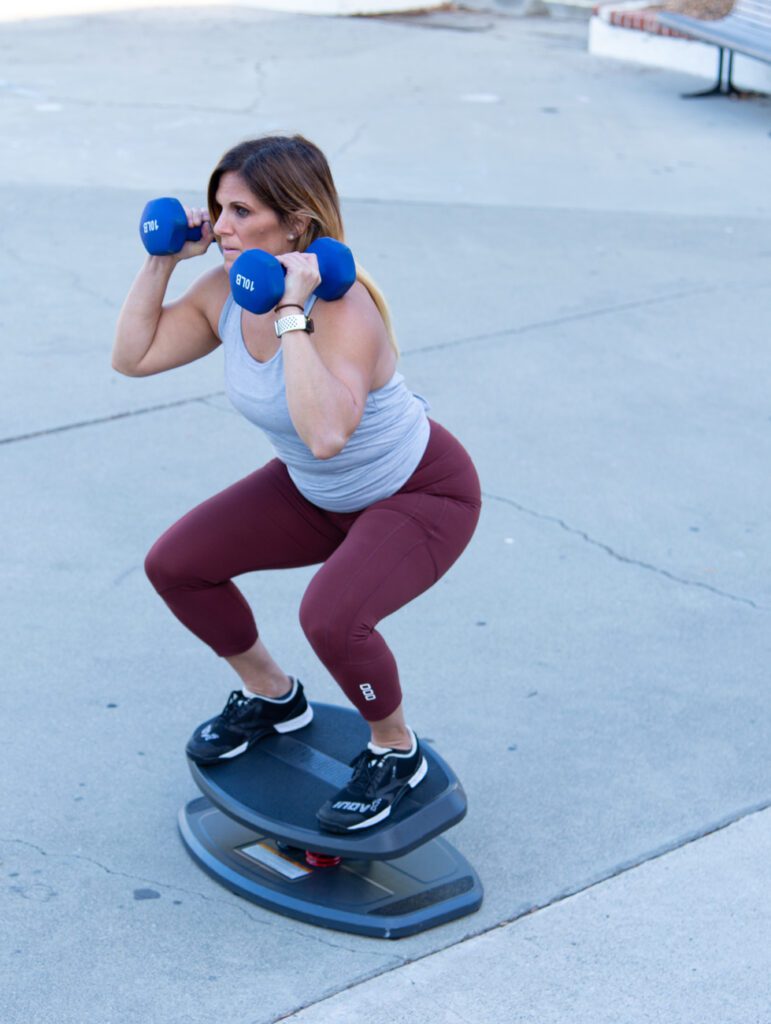
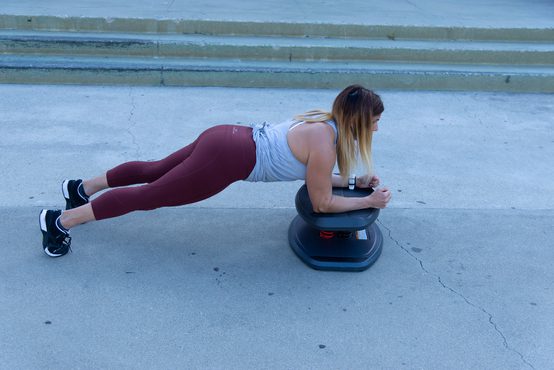
At first glance, it looks like a balance board — but it’s so much more than that. The StrongBoard responds dynamically to movement, creating an unstable surface that requires the body to activate stabilizing muscles in real time. That means when you perform exercises on it — squats, lunges, push-ups, planks, even glute bridges — your body is working harder to control, stabilize, and produce force safely.
Strength + Stability = Smarter Training
One of the biggest reasons I use the StrongBoard is because it trains strength and stability simultaneously.
Traditional strength training primarily works muscles in controlled, linear patterns. But real life isn’t linear — we twist, pivot, catch ourselves, shift weight, and move in multiple planes. Training on an unstable surface helps bridge that gap between gym strength and real-world function.
By incorporating the StrongBoard into strength training for women, clients improve:
- Core engagement
- Joint stability
- Balance and coordination
- Neuromuscular control
- Injury resilience
It challenges the smaller stabilizing muscles that often get overlooked but are critical for long-term strength and joint health.
Especially Valuable for Women Navigating Hormonal Changes
For many of my clients, I’m programming with a deeper lens — particularly women in perimenopause and menopause.
Hormonal shifts during this phase can impact:
- Muscle mass
- Bone density
- Recovery capacity
- Balance and proprioception
- Joint integrity
That’s where tools like the StrongBoard become incredibly effective. Training on an unstable surface helps rebuild neuromuscular connection while still allowing us to focus on progressive strength work.
This is why I often integrate it into strength training for hormonal balance programs. It allows women to build strength in a way that supports their changing physiology — not work against it.
We’re not just lifting heavier. We’re training smarter.
Customization Within Personalized Programming
No two clients train the same way inside my gym.
Because I provide personalized workout plans for women, the StrongBoard becomes a versatile programming tool. For some clients, it may be used for foundational balance and stability. For others, it becomes a progression tool to increase core demand and movement complexity.
Sometimes it is used for basic movements we do “on land” as I like to refer to exercises not on a StrongBoard such as squats, lunges, planks, deadlifts, overhead presses. It can also be used for more balance board specific and more advanced exercises too, like teeter totters or half circles. Which you are wondering what those are. Well, you will just have to come train with me to find out.
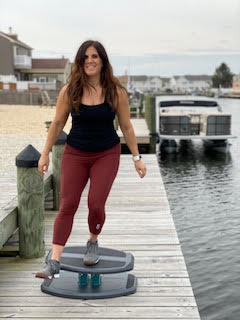
No matter where you are in your fitness journey, the instability can be scaled up or down, making it appropriate for both beginners and advanced clients.
A Perfect Fit for a Private Training Environment
Working inside a private gym personal trainer for women setting allows me to coach these movements closely and safely.
Because sessions are either 1:1 or semi-private, I can:
- Cue form in real time
- Adjust positioning instantly
- Modify based on injuries or limitations
- Progress difficulty appropriately
That level of coaching ensures clients get the benefits of instability training without compromising safety.
More Than a Balance Tool
At the end of the day, the StrongBoard isn’t just about balance — it’s about building resilient, capable bodies.
And it adds variety to training without adding joint stress, which is especially important for women who want to train hard while still respecting recovery and longevity.
When used strategically within a well-designed program, it becomes a powerful complement to traditional lifting — supporting the bigger picture of strength, health, and sustainability.
Ready to get on board? Reach out for your PT Consult to get started.

View comments
+ Leave a comment